Maya Tran
July 15, 2026
•
16 min read
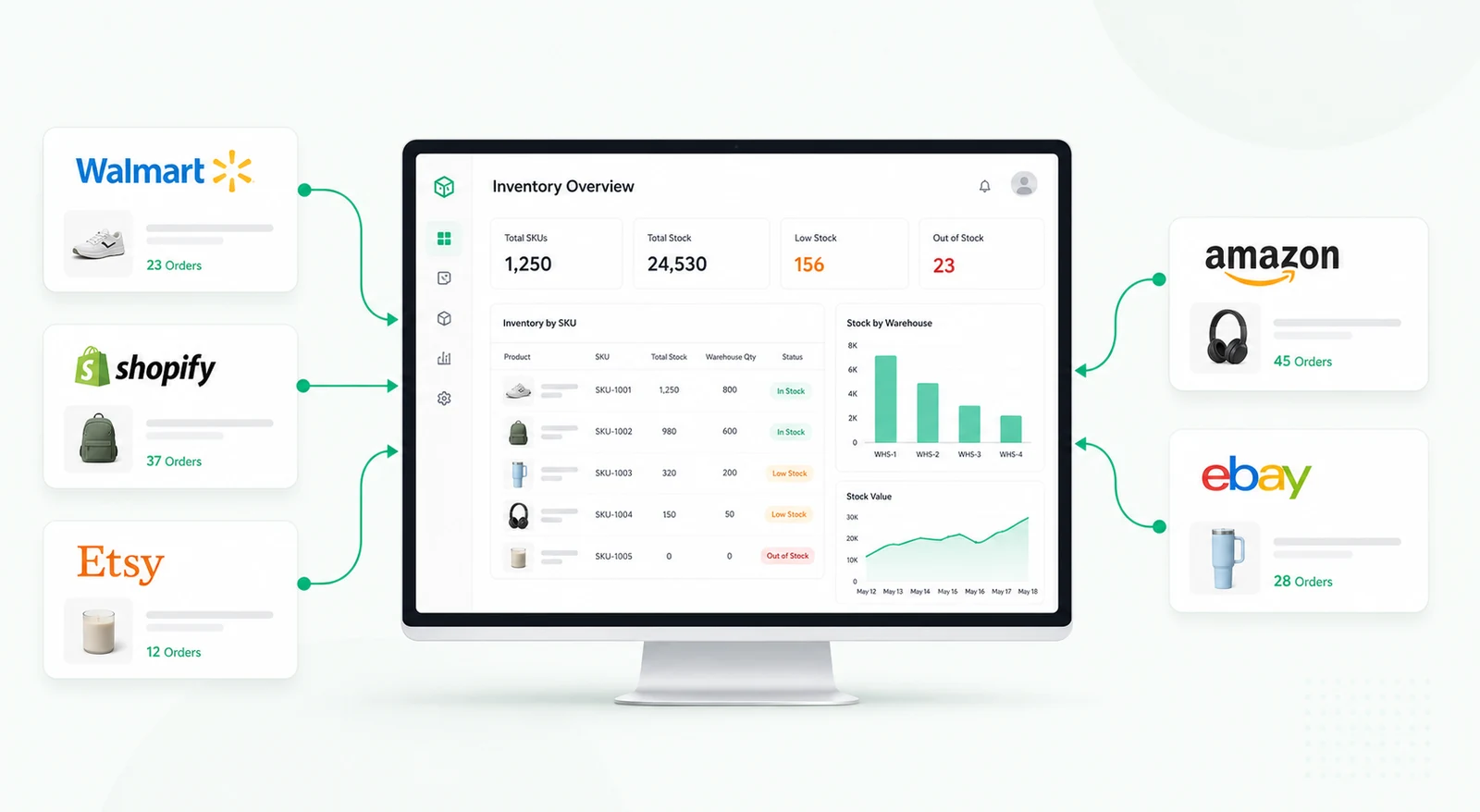
Selling on Shopify, Amazon, Walmart, Etsy, eBay, retail stores, and wholesale portals can expand demand quickly. It can also create a dangerous inventory problem: every channel accepts orders from stock that may already have been promised somewhere else.
Multichannel inventory management solves more than stock synchronization. It establishes which system owns each number, how inventory is reserved and allocated, how warehouses and channels exchange updates, and how teams recover when data or physical stock disagrees. This guide explains the systems, workflows, controls, and best practices needed to make that operation dependable.
Multichannel inventory management is the process of tracking, allocating, replenishing, and controlling inventory across every place a business sells and fulfills orders. Those places can include ecommerce storefronts, marketplaces, social commerce, physical stores, wholesale accounts, warehouses, third-party logistics providers, and dropshipping partners.
The objective is not simply to display one inventory number everywhere. It is to provide each channel with an accurate sellable quantity while protecting commitments, safety stock, location constraints, and fulfillment promises.
A multichannel business sells through several channels. An omnichannel business also coordinates the customer and fulfillment experience across those channels. A merchant selling independently on Amazon and Shopify is multichannel. If customers can buy online, collect from a store, return elsewhere, and see consistent availability throughout, the operation is moving toward omnichannel.
Both models require accurate inventory. Omnichannel operations add stronger requirements for order routing, location-level availability, returns, and customer-facing delivery promises.
Shopify, Amazon, Walmart, Etsy, and eBay store listing and inventory data differently. Updates arrive through separate APIs and events. If two channels sell the last unit before either receives the other channel's update, overselling can occur.
One item may have an internal SKU, an Amazon seller SKU, several Etsy listings, and a Shopify bundle SKU. Without a canonical product record and mapping layer, systems may treat these listings as independent stock.
A warehouse may hold 500 units, but some may be reserved, damaged, under inspection, committed to wholesale, or protected as safety stock. Publishing all 500 units creates false availability.
A unit in one region cannot always satisfy an order promised elsewhere. Location activation, fulfillment capability, shipping cost, and customer proximity determine whether stock is truly available.
A smaller merchant may use one ecommerce-first platform for several jobs. A larger operation may connect dedicated systems. Every responsibility still needs one defined owner.
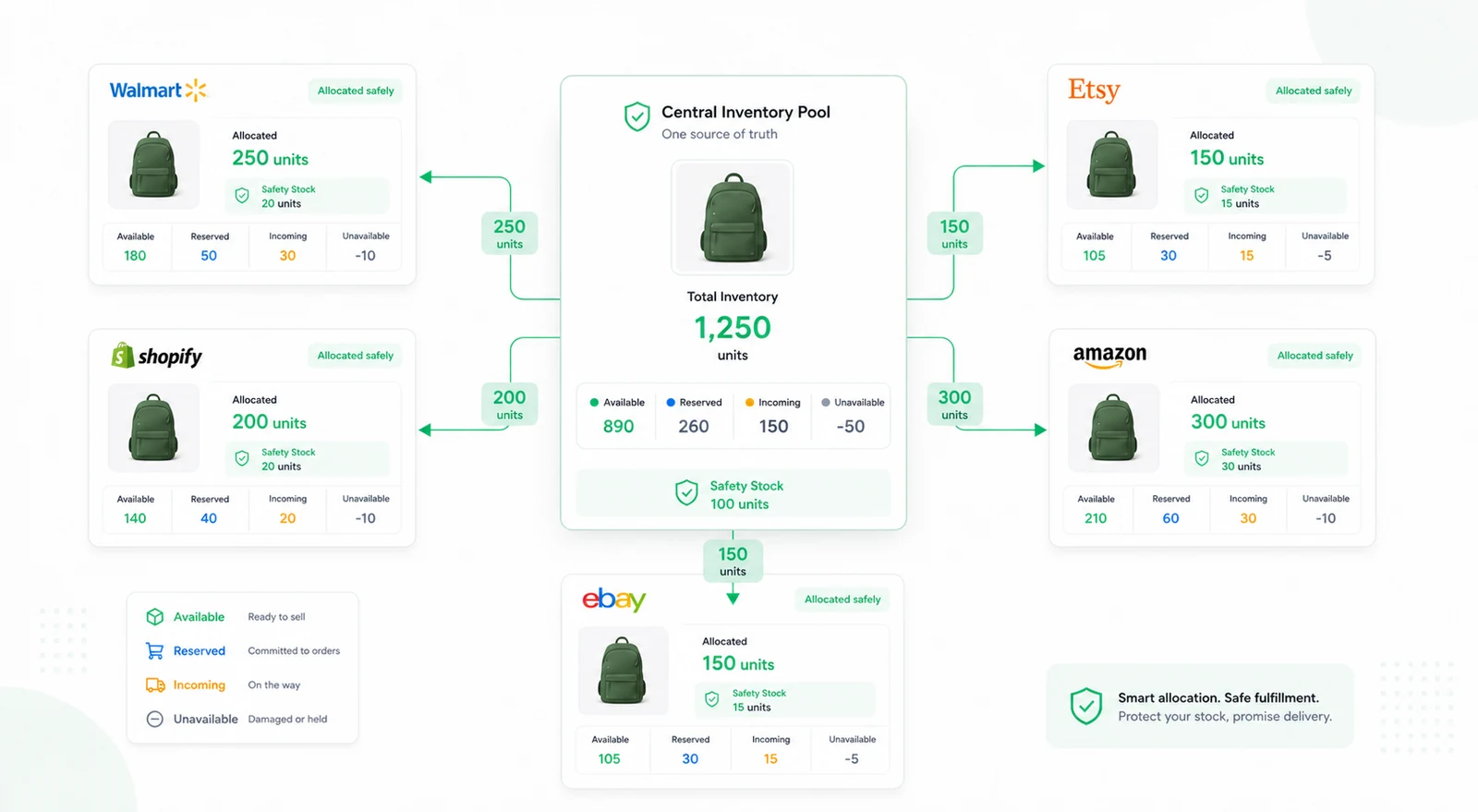
A single source of truth does not require storing everything in one database. It means each critical fact has an authoritative owner. A practical model may assign product identity to the IMS or ERP, physical stock to the WMS, reservations and sellable quantity to the IMS or OMS, financial value to accounting, and listing content to the ecommerce platform or PIM.
When systems disagree, this ownership model determines which value wins and which record must be corrected. Without it, integrations can create loops in which one platform repeatedly overwrites another.
A simplified formula is: sellable quantity = on hand − reserved − unavailable − safety stock. The actual formula should reflect business rules. Incoming stock should not become sellable simply because a carrier says it is on the way.
Many merchants begin with one shared pool. Every listing points to a canonical SKU, and each reservation reduces the quantity published across connected channels. This maximizes availability.
Exposing the whole pool everywhere is not always safe. Allocation is useful when wholesale orders have commitments, subscriptions need protected units, DTC produces higher margins, a marketplace reports slowly, a promotion could consume scarce stock, or particular warehouses serve particular channels.
Rules can reserve fixed units, percentages, location quantities, or dynamic buffers. They should be documented so teams understand why a channel appears sold out while stock remains elsewhere.
Every physical item needs a canonical SKU. Channel SKUs, listing IDs, ASINs, variants, bundles, multipacks, and barcodes must map back to it. Unknown listings should enter an exception queue instead of bypassing synchronization.
Reconcile the system against physical stock and establish a cutover time so historical orders and adjustments are not processed twice.
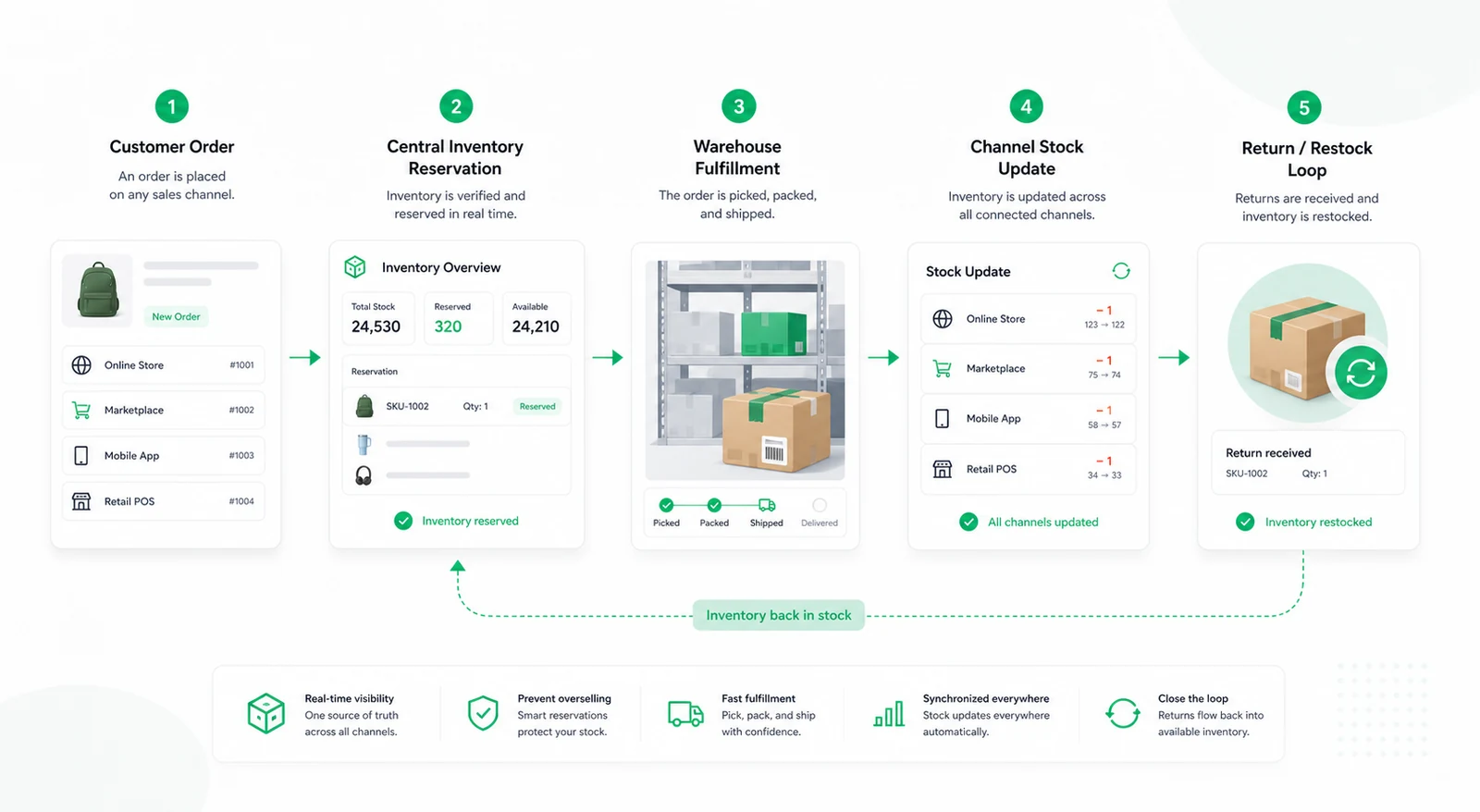
When an order arrives, validate its mapping and create a reservation immediately rather than waiting for shipment.
Subtract the reservation, apply allocation and safety-stock rules, then push updated quantities to connected listings.
Select a location based on inventory, proximity, delivery promise, shipping cost, split-shipment rules, and warehouse capability. Shipment confirmation flows back to the channel; reserved inventory becomes fulfilled rather than being deducted twice.
A cancellation releases its reservation. A return enters receiving and inspection. Only restockable units move back to available inventory.
Bundles cause errors because channels often track the finished listing without understanding its components. If a gift set contains one candle, two soaps, and one bag, its available quantity is determined by the scarcest component. A sale must reduce each component and recalculate every other bundle using them.
The same logic applies to multiple listings for one product, cases purchased and sold as individual units, multipacks, custom goods made from common blanks, and separate retail and wholesale packaging. Bundle definitions should be audited because a ratio change can alter stock across many listings.
Central visibility does not mean pooling every location indiscriminately. Each location should record whether it can fulfill online orders, its products, service region, processing time, and channel restrictions.
Routing may prioritize the nearest location, a complete shipment, lowest cost, earliest delivery, older inventory, or a marketplace-specific warehouse. Platform routing features help within one ecosystem, but cross-channel control still requires consistent rules and a central view.
Replenishment should use combined SKU demand rather than treating channels as separate businesses. A practical workflow calculates total sales velocity, applies lead time and safety stock, subtracts open purchase orders and transfers, respects minimum quantities and pack sizes, creates an approved PO, then records partial or full receipt.
Receiving must capture shortages, overages, damage, and inspection status. Incoming units remain separate until accepted; publishing them early risks selling stock that is late, short-shipped, or damaged.
Returns are inventory events, not only support events. Returned units may be unopened, damaged, incomplete, counterfeit, or suitable for refurbishment. Record the originating order, channel, SKU, quantity, location, condition, disposition, and refund status.
The disposition determines whether a unit returns to available stock, moves to a secondary grade, remains quarantined, or is written off. Cross-channel returns require special care because a unit returned through one partner should not reappear elsewhere before inspection.
Synchronization cannot guarantee physical accuracy. Shrinkage, mispicks, damage, samples, receiving mistakes, and manual changes create drift. Scheduled reconciliation should compare the central system with channels and warehouses and create exceptions when differences exceed defined tolerances.
Every adjustment needs an owner, reason, source values, old quantity, new quantity, and timestamp. Cycle counts add physical control. High-value and fast-moving “A” items should be counted more often than lower-impact “B” and “C” stock.
Marketplace APIs throttle requests, webhooks arrive late, credentials expire, and services become unavailable. Reliable designs expect this.
A connection can be technically active while its data is stale. The dashboard must make that distinction visible.
List every channel, location, system, SKU format, inventory state, and adjustment workflow. Define the desired source of truth.
Normalize SKUs, map listings, define bundles, remove duplicates, and resolve unknown records before automating writes.
Compare systems without updating channels. Use this period to uncover timing differences, missing events, and invalid assumptions.
Enable one channel or product group at a time. Test sales, cancellations, returns, transfers, partial receiving, and bundle consumption.
Add allocation, safety stock, reorder points, and purchase recommendations after transactional data is reliable. Track latency, oversells, stockouts, variance, and exception age.
Evaluate tools against the real operation. Ask whether they support current and future channels, map different SKUs, calculate bundles at component level, represent warehouses, manage purchase orders and partial receipts, separate inventory states, configure allocation, expose failed syncs, preserve audit history, provide API access, and scale affordably with orders and SKUs.
For ecommerce businesses managing inventory across multiple sales channels, platforms like Sumtracker help centralize inventory operations, including inventory sync, purchase orders, bundles, and inventory replenishment across Shopify, Amazon, and other marketplaces.
Ecommerce-first systems can suit growing brands needing synchronization, bundles, purchasing, and replenishment without a heavy ERP. Complex manufacturing, wholesale, or financial operations may require a broader stack.
Even when an inventory platform handles synchronization, teams often need a control layer across the IMS, marketplaces, 3PL, ERP, and supplier data. A Retool dashboard can provide cross-system inventory visibility, SKU-mapping queues, allocation approvals, inbound shipment tracking, bundle diagnostics, failure monitoring, replay tools, and controlled adjustments.
See our related guide to solving ecommerce inventory and import issues with Retool dashboards.
Multichannel inventory management is not copying one number to several stores. It is a controlled flow of product identity, reservations, physical movements, sellable quantities, and exceptions across systems.
The strongest operations establish ownership, publish only stock that can truly be promised, reserve early, treat returns carefully, reconcile continuously, and make failures visible.
If your team needs a dashboard connecting inventory, ecommerce, warehouse, and supplier systems, book a strategy call with Retoolers. We can turn fragmented data into an internal tool your operators can trust.
Looking to supercharge your operations? We’re masters in Retool and experts at building internal tools, dashboards, admin panels, and portals that scale with your business. Let’s turn your ideas into powerful tools that drive real impact.
Curious how we’ve done it for others? Explore our Use Cases to see real-world examples, or check out Our Work to discover how we’ve helped teams like yours streamline operations and unlock growth.

Before we quote, we help you clarify the workflow. Share your idea, process, or existing tools, and we’ll map the key requirements, suggest the right system, and create a free wireframe so you can see the solution before development starts.